Syllabus

Download

Course Schedule
#DateContent and ReadingsReadings
1Tue, 08/26Getting Started: Why are we talking about work?
How to College: Reading the Syllabus: How to!??
Schwarz (2014)
Cuddy (2012)
2Thu, 08/28How to College: The Hidden Curriculum: Expectations & Norms in CollegeBaldwin (2020)
3Tue, 09/02PSYC: Why do we work? What makes work fun?
Work motivation, growth mindset, and self-efficacy
Rhew, Piro, Goolkasian, & Cosentino (2018)
4Thu, 09/04How to College: Career Readiness: Employers’ Expectations and Employers’ Complaints; Time managementNACE (2025)
5Tue, 09/09PSYC: The social contract and the psychological contractEdwards, & Karau (2007)
6Thu, 09/11Campus Resources 1: The Secret Life of Colleges:
Campus offices; online systems, student life

BC Knowledge for Students
7Tue, 09/18PSYC: Psychological safety at work Edmondson (1999)
8Thu, 09/18Campus Resources 2: Library and LibrariansLibrary
Tue, 09/23No classes scheduled!
9Thu, 09/25PSYC: Work-life balance and the culture of overworkingRo (2021)
Choose one: Taris & de Jonge (2024) or: Wong et al. (2019)
10Tue, 09/30PSYC: LeadershipRubenstein (2005)
Thu, 10/02No classes scheduled!  –
11Tue, 10/07PSYC: Work & Human Factors: Knowledge, skills, abilities, decisions, thinking, problem solvingGranillo, Musemeche, & Reyes (2025)
12Thu, 10/09Campus Resources 3: Learning Center &
Magner Center for Career Development
Learning Center
Magner Center
Tue, 10/14Conversion Day, classes follow Monday schedule –
13Thu, 10/16Midterm ExamReview all readings and contents
14Tue, 10/21PSYC: Ethics and values at work, person-organization fitChabon (2011)
Morley (2007)
15Thu, 10/23CAREER: Career Interview Preparation: create interview guide about your interviewee’s career, job, and outlook on workReview all psych readings so far to prepare for this session
Computer Lab 4607 James Hall
16Tue, 10/28PSYC: Perceiving Groups & Social IdentityFiske (2013)
17Thu, 10/30CAREER: What do you want to do with your life?
Learn about your interests
Computer Lab
4607 James Hall
18Tue, 11/04PSYC: Communication & GroupsShatz (2025)
Forsyth (2014)
19Thu, 11/06CAREER: Find Your Major! Match your interests to a major that will get you to your career;
Find Your Degree Map! Get your hands on the plan for completing your degree
Computer Lab
4607 James Hall
20Tue, 11/11WORKFORCE: Historic Trends in the Workplace: From employment to unemployment to retirement Beard (2017)
21Thu, 11/13How to College: How to give a good presentation Anderson (2013)
22Tue, 11/18WORKFORCE: The Current Trends: From the Gig Economy to Influencers to AntiworkDua et al. (2022); Whang (2022); O’Connor (2022)
23Thu, 11/20Campus Resources 4: Personal Counseling Center & Center for Student Disability Services &
Health and Wellness
Counseling Center
Student Disability Services
Health and Wellness
24Tue, 11/25WORKFORCE: Alternative Models of Work: From UBI to 4-hour work weekPeters et al. (2024); Wheeler (2023); The 4-hour work week (2025)
Thu, 11/27Thanksgiving – College Closed (Nov 27-30, 2025)
25Tue, 12/02Presentations
26Thu, 12/04Presentations
27Tue, 12/09WORKFORCE: The Future of Work: From automation to AI, skills for the future, jobs with bright outlookZahidi (2025)
Wheeler (2025)
28Thu, 12/11Course Review and Finals PrepReview all materials covered in this class
29Thu, 12/18Final Exam! Thursday 1-3PM!!!Review all materials covered in this class
Coursework: Exams and Assignments

The first core goal of this class is for you to understand and develop your career goals and learn how you can achieve them. The second core goal of this class is for you to get acquainted with college life and its expecations. All coursework including the exams will prepare you for these two goals.

TitleBrief Explanation% of final gradeCareer Skills Practiced
Project PlanCreate a weekly plan for all your assignments in all your classes this semester (e.g., Excel, project plan, Gantt chart). Include all deadlines in this plan. The aim of this assignment is to help you avoid missing deadlines and losing track of your work.10%technology skills; communication skills
Career PlanWrite-up your career goals and the detailed plan to fulfill them (e.g., paper, poster, presentation, infographic). You will present this in class in front of your classmates.10%career & self-development skills; technology skills
Expert Interview & ReportInterview: Conduct an interview with a person of your choice who has been in their career for a while and knows their job well. Ask them about their career trajectory. We will prepare an interview guide together in class, but you will conduct the interview on your own outside of class. Report: Write up the interview in the for you prefer (e.g., essay, oral presentation, poster presentation, video presentation).20%Research skills; communication skills; technology skills
Online SurveysComplete all online surveys that are related to the class content. These surveys will also help you prepare for the career interview. There are no right or wrong answers to the questions. This assignment is pass/fail (100% if all completed; 0% if not completed or some missing).10%Career & self-development skills; research skills
Attendance, Participation, TeamworkBe actively present in class. This includes coming to all classes, participating in class discussions, collaborating with other students in class and in your team.10%Teamwork and professionalism skills
Midterm ExamThe midterm exam will cover predominantly the psychology topics. This exam will help you prepare for the career interview assignment.15%Studying and test-taking skills
Final ExamThe final exam will be cumulative. It will cover all content covered in this course. Reading all assigned readings, completing all homework, and actively working with your team on the in-class projects will make it easy to prepare for this exam.25%Studying and test-taking skills
Coursework: Time Commitment

Some of these coursework assignments will be completed during class, either alone or in teams. Other assignments you will complete outside of class and will have to allocate time outside of class to complete them. Here is a table that shows how much time you will need to allocate approximately: 

Assignment Where is it done? Approximate time needed 
Interview guide for career interview In class 1 class session (75 min) 
Career plan: preparation In class 1 class session (75 min) 
Exams: Midterm exam,  
Final exam 
In class In class 1 class session (75 min) 1 class session (120 min) 
Online surveys Outside of class 5-10 minutes per week 
Project plan write up Outside of class 3-5 hours (one time) 
Conduct interview  Outside of class 1-2 hours (one time) 
Write up interview report Outside of class 2-4 hours (one time) 
Career plan: write up and report Outside of class 2-4 hours (one time) 
Grading
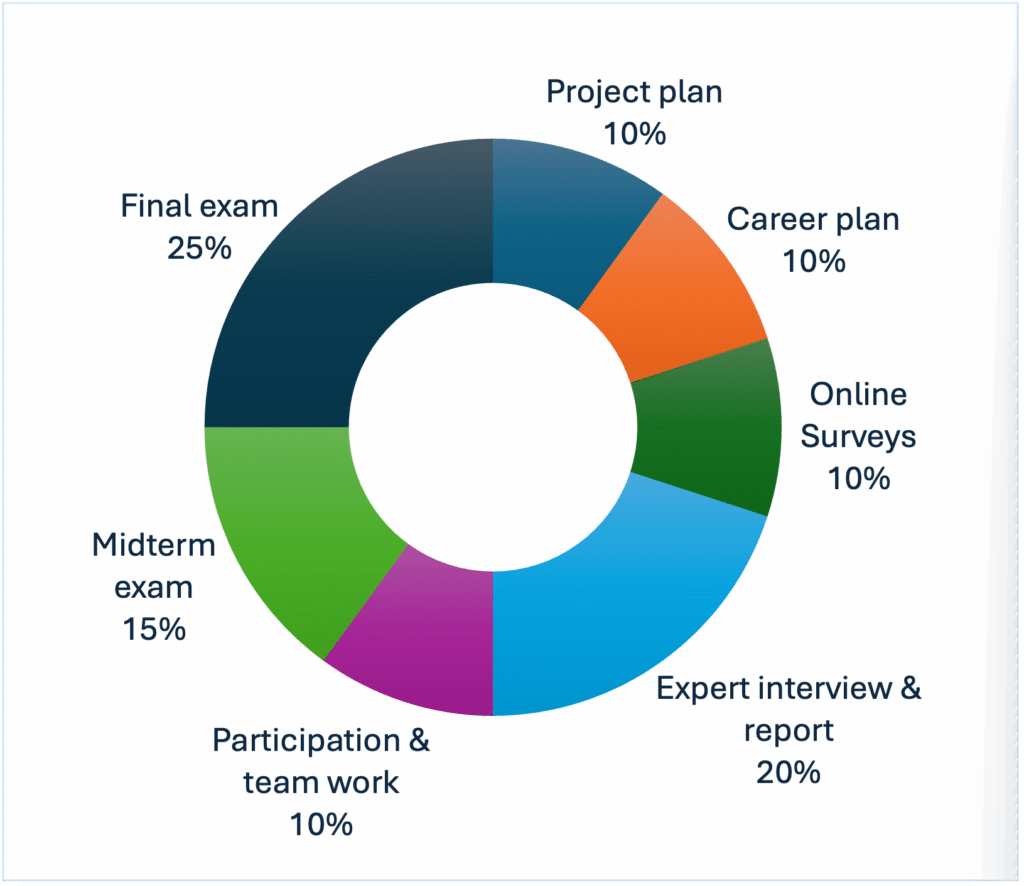
Pie chart of grade components: project plan 10%, career plan 10%, online surveys 10%, expert interview and report 20%, participation and team work 10%, midterm exam 15%, final exam 25%.
Class Guidelines

  1. Act equitably with integrity and accountability to self, others, and the college. Maintain a positive personal brand in alignment with college and personal career values.
  2. Be present and prepared. Demonstrate dependability (e.g., report consistently for class or meetings).
  3. Prioritize and complete tasks to accomplish course goals. Consistently meet or exceed goals and expectations.
  4. Have attention to detail, resulting in few if any errors in your work. Show a high level of dedication toward doing a good job. If you make errors, correct them with grace.

You will create a project plan at the beginning of the semester to avoid needing extensions on deadlines or missing exams. However, life happens. If you need an extension, let me know by email ([email protected]). Explain briefly what prevented you from completing the assignment on time and tell me when you will submit it.  

Please note that all coursework is built on previous work we have done. You will need to submit the assignments in the order in which they were expected to be completed.  

Retaking missed exams later than the rest of the class will only be permitted for severe reasons. If you had to miss an exam and are uncertain if your reason qualifies, please speak with me (in class or by email: [email protected]). 

The faculty and administration of Brooklyn College support an environment free from cheating and plagiarism. Each student is responsible for being aware of what constitutes cheating and plagiarism and for avoiding both.  

The complete text of the CUNY Academic Integrity Policy and the Brooklyn College procedure for implementing that policy and including all other policies can be found at this site: https://www.brooklyn.edu/policies/.  

If a faculty member suspects a violation of academic integrity and, upon investigation, confirms that violation, or if the student admits the violation, the faculty member MUST report the violation. Ignorance (“I did not know”) will not be accepted as an excuse for cheating, plagiarism, or academic dishonesty of any kind.  

If you are caught cheating during an exam, or if you plagiarize any of your work, or you use AI to write it for you, you will fail the assignment (Grade: 0%, zero) and this course (Grade F).  

Using any Artificial Intelligence (AI) software for completing your class assignments is not permitted for any portion of this class. This means, it is forbidden to use AI to write text or any kind for any of the assignments. You may not use AI to create text, images, graphs, or any product that you are expected to produce as your own work or any part of your work. You must write all the text in your own voice, as well as create any posters, graphics, images, or other output that you are expected to create yourself. 

Violations of this policy will be treated like other cheating incidents and will result in a grade of 0 (Zero) for the assignment. Depending on the severity of the violation, you will be reported to the Academic Integrity Committee, which could potentially result in your dismissal from college.  

You may use AI to help you research topics you are interested in. The most important thing to know is that AI is only as smart as you are. You will not learn anything if you are using it in the wrong manner. 

Important College Dates
DateDescription
08/25  Last day to drop class for 100% refund  
08/26  First day of classes  
08/30-31 No classes scheduled 
09/01 Last day to add or swap a course Last day to drop for a 75% tuition refund Financial Aid Certification Enrollment Status Students dropped from waitlist College Closed, no classes scheduled 
09/02 A Grade of WD will be assigned to students who officially drop a class Verification of Enrollment Rosters available to faculty 
09/05 Last day to submit a Pass/Fail Elective 
09/08 Last day to drop for a 50% tuition refund Last day for students to submit requests for change, deletion of, or declaration of a major/minor/concentration to be effective for Fall 2025 
09/13 Last day for departments to approve requests for change, deletion, or declaration of a major, minor, or concentration to be effective Fall 2025 
09/15 Last day to drop for a 25% tuition refund Last day to drop a course with a WD grade  Last day to file for Fall 2025/ Dec 31, 2025 and Winter 2026/February 1, 2026 graduation on CUNYfirst 
09/16  A Grade of WN is Assigned for Students Marked as “Never Attended” on the Verification of Enrollment Rosters Grade of W is Assigned to Students Who Officially Withdraw from a Course 100% Tuition Liability Begins for Any Drops 
09/22 & 09/24  No classes scheduled  
10/01-10/02 No classes scheduled 
10/13 College Closed, no classes scheduled 
10/14 Conversion day, classes follow a Monday schedule 
10/20 College Closed – no classes scheduled 
10/24 Conversion day, classes follow a Monday schedule 
10/29 Declaration of Major Queue Reopens; Majors/Minors/Concentrations Declared Starting this Date Will be Effective for Spring 2026 
11/06 Last day to withdraw from a course with a grade of W 
11/27–28 11/29-30 College Closed, no classes scheduled  No classes scheduled 
11/30 Last day to complete and submit INC work from previous semester (Spring 2025)  
12/15 Last day of undergraduate classes Last day to submit proof of NYS residency for Fall 2025 tuition adjustment 
12/16-22 Final Examinations Begin  
12/24-25  College closed 
12/26 Final Grade are posted  

The full academic calendar, including many other important dates, and the undergraduate final exam “grid” are available on the Office of the Registrar’s website.  

Brooklyn College and CUNY Policies

Students who experience the death of an immediate family member must contact the Division of Student Affairs, 2113 Boylan Hall, at 718.951.5352 or via email if they wish to implement either the Standard Bereavement Procedure or the Leave of Absence Bereavement Procedure (see website). The Division of Student Affairs has the right to request a document that verifies the death (e.g., a funeral program or death notice). For more information, see website.

Students requesting a religious accommodation should contact the Division of Student Affairs. The chief student affairs officer, or a designee, and the student will engage in an interactive process with the goal of finding an acceptable accommodation. To contact the Division of Student Affairs, 2113 Boylan Hall, at 718.951.5352 or via email .

Consistent with New York State Education Law Section 224-a, students who are absent from school because of a religious belief will be given the equivalent opportunity, without any additional fee charged, to register for classes or make up any examination, study or work requirements missed because of such absence on any particular day or days. 

The Center for Student Disability Services (CSDS) is committed to ensuring students with disabilities enjoy an equal opportunity to participate at Brooklyn College, and so am I. In order to receive disability-related academic accommodations, students must first be registered with CSDS. Students who have a documented disability or suspect they may have a disability are invited to call the CSDS at (718) 951-5538 or visit 138 Roosevelt Hall.

In order to receive academic accommodations students must first be registered with the Center for Student Disability Services. Students who have a documented disability or who suspect that they might have a disability are invited to set up an appointment with the Director of the Center for Student Disability Services, Ms. Valerie Stewart-Lovell or the Assistant Director, Josephine Patterson or their general email [email protected]

If you have already registered with CSDS and submitted necessary forms, you will receive your course accommodation letter to provide to your professor and these specific accommodations can be discussed when appropriate.

Center for Student Disability Services (CSDS) Mission:
It is the mission of the Center for Student Disability Services (CSDS) to ensure that students with disabilities have equal access to all campus facilities, curricula, and activities. The program’s objective focuses on providing students with reasonable disability-related accommodations and the opportunity to maximize their academic success at Brooklyn College. The goal is to ensure an inclusive environment while maintaining and enhancing the college’s academic excellence by providing students with disabilities the opportunity to achieve their highest possible academic potential.

Brooklyn College Resources

Students who experience the death of an immediate family member must contact the Division of Student Affairs, 2113 Boylan Hall, at 718.951.5352 or via email if they wish to implement either the Standard Bereavement Procedure or the Leave of Absence Bereavement Procedure (see website). The Division of Student Affairs has the right to request a document that verifies the death (e.g., a funeral program or death notice). For more information, see website.

The Brooklyn College Learning Center (LC) provides peer tutoring in accordance with national best practices that empower students to cultivate the skills and behaviors of confident, independent, and lifelong learners. With support from the Office of Institutional Research and Data Analysis and ongoing oversight from the Provost and Senior Vice President for Academic Affairs, the LC designs relevant interventions for need areas to further Brooklyn College’s efforts to stimulate student-driven learning as well as increase retention rates and on-time graduation.  

The CSDS, located in 138 Roosevelt Hall, is committed to ensuring that students with disabilities enjoy an equal opportunity to participate in the classrooms, programs, and services that the college has to offer by facilitating the necessary accommodations. According to the Americans with Disabilities Act, no otherwise qualified person with a disability shall be denied a benefit or opportunity or be excluded from participation solely on the basis of that disability.   The Center for Student Disability Services (CSDS) is currently delivering services in-person and remotely. Please e-mail them at [email protected] or call 718.951.5538 for assistance. 

Personal counseling services are available to Brooklyn College undergraduate and graduate students. A staff of psychologists and social workers are available to assist you with personal problems you may experience during your college years. Emergency consultations and referrals to outside services are also provided. All services at the center are free and confidential. No information is released without consent of the student. Appointments for services may be made in person (0203 James Hall), by phone (718.951.5363), or email ([email protected]). If you feel confused, upset, stressed, or depressed, if you feel totally overwhelmed and don’t know what to do, please consider going to personal counseling. If useful, some self-evaluation tools here. 

The Magner Career Center is a great resource, not only when you hit the job market. They will provide resources so you can find internships, provide stipends for unpaid internships (competitive), and they can connect you with employers and successful alumni through their job fairs. They organize company visits, workshops, provide career counseling, help you with your résumé and job application, and much more! Make sure you use this valuable resource that our college provides for free as part of your tuition. 

Readings By Author

Anderson, C. (2013). How to give a killer presentation. Harvard Business Review, June 2013.
https://hbr.org/2013/06/how-to-give-a-killer-presentation

Baldwin, A. (2020, March 27). College culture and expectations. In A. Baldwin, College Success, Chapter 1.3., OpenStax  https://openstax.org/books/college-success/pages/1-3-college-culture-and-expectations 

Beard, Z. (2017). Why we work: An Analysis of Work Purpose. Career Planning & Adult Development Journal, 33(2), 32–35.   [https://cuny-bc.primo.exlibrisgroup.com/permalink/01CUNY_BC/ljnr3v/cdi_proquest_reports_2019971505]

Chabon, S. (2011). Ethics at work: Issues and insights across employment settings. Seminars in Speech and Language, 17(4), 277–278. https://doi.org/10.1055/s-0031-1292752    [https://cuny-bc.primo.exlibrisgroup.com/permalink/01CUNY_BC/ljnr3v/cdi_unpaywall_primary_10_1055_s_0031_1292752]

Cuddy, A. (2012, June). Your body language may shape who you are [Video]. Ted Conferences. https://www.ted.com/talks/amy_cuddy_your_body_language_may_shape_who_you_are

Dua, A., Ellingrud, K., Hancock, B., Luby, R., Madgavkar, A., Pemberton, S. (2022). Freelance, side hustles, and gigs: Many more Americans have become independent workers. McKinsey & Company, August 23, 2022. https://www.mckinsey.com/featured-insights/sustainable-inclusive-growth/future-of-america/freelance-side-hustles-and-gigs-many-more-americans-have-become-independent-workers#/

Edmondson, A. (1999). Psychological Safety and Learning Behavior in Work Teams. Administrative Science Quarterly, 44(2), 350-383. https://doi-org.brooklyn.ezproxy.cuny.edu/10.2307/2666999 [https://cuny-bc.primo.exlibrisgroup.com/permalink/01CUNY_BC/ljnr3v/cdi_unpaywall_primary_10_2307_2666999]

Edwards, J. C., & Karau, S. J. (2007). Psychological contract or social contract? Development of the employment contracts scale. Journal of Leadership and Organizational Studies, 13(3), 67-78. https://doi.org/10.1177/10717919070130030601    [https://cuny-bc.primo.exlibrisgroup.com/permalink/01CUNY_BC/ljnr3v/cdi_proquest_journals_203138570]

Fiske, S. T. (2013). Prejudice, discrimination, and stereotyping. In R. Biswas-Diener & E. Diener (Eds), Noba textbook series: Psychology. Champaign, IL: DEF publishers. DOI: nobaproject.com.    https://nobaproject.com/textbooks/introduction-to-psychology-the-full-noba-collection/modules/prejudice-discrimination-and-stereotyping

Forsyth, D. R. (2014). The psychology of groups. In R. Biswas-Diener & E. Diener (Eds), Noba textbook series: Psychology. Champaign, IL: DEF publishers. DOI:nobaproject.com.
https://libguides.brooklyn.cuny.edu/ld.php?content_id=35276255

Granillo, V. K. E., Musemeche, N. P., & Reyes, D. L. (2025). Mapping the modern workforce: An overview of workforce competency demands. Career Development Quarterly, 73(1), 48–67. https://doi-org.brooklyn.ezproxy.cuny.edu/10.1002/cdq.12367    [https://cuny-bc.primo.exlibrisgroup.com/permalink/01CUNY_BC/ljnr3v/cdi_proquest_journals_3180214359]

Hagerty, J. R. (2024). How students can AI-proof their careers; artificial intelligence is going to eliminate a lot of jobs in the future. It’s possible to reduce the risk that it will be yours. Wall Street Journal (Online). New York, N.Y.: Dow Jones & Company Inc.    Retrieved from https://brooklyn.ezproxy.cuny.edu/login?url=https://www.proquest.com/blogs-podcasts-websites/how-students-can-ai-proof-their-careers/docview/3130735754/se-2 [https://cuny-bc.primo.exlibrisgroup.com/permalink/01CUNY_BC/ljnr3v/cdi_proquest_miscellaneous_3130735754]

McKinsey Global Institute (2023). Generative AI and the future of work in America. July 26, 2023. Report https://www.mckinsey.com/mgi/our-research/generative-ai-and-the-future-of-work-in-america

McMahon, M. (2017). Work and why we do it: A systems theory framework perspective. Career Planning & Adult Development Journal, 33(2), 9–15.    [https://cuny-bc.primo.exlibrisgroup.com/permalink/01CUNY_BC/ljnr3v/cdi_proquest_reports_2019971926]

Morley, M. J. (2007). Person‐organization fit. Journal of Managerial Psychology, 22(2), 109-117. https://doi.org/10.1108/02683940710726375    [https://cuny-bc.primo.exlibrisgroup.com/permalink/01CUNY_BC/ljnr3v/cdi_emerald_primary_10_1108_02683940710726375]

NACE (2025) What is Career Readiness?, Available at: https://www.naceweb.org/career-readiness/competencies/career-readiness-defined  (Accessed: 14 August 2025).

O’Connor, B. (2022). The rise of the anti-work movement. BBC.com, January 27, 2022. https://bbc.com/worklife/article/20220126-the-rise-of-the-anti-work-movement

Peters, K., Kelly, R.C., Rubin, D. (2024). What Is Universal Basic Income (UBI), and How Does It Work? Investopedia, July 10, 2024. https://www.investopedia.com/terms/b/basic-income.asp

Rhew, E., Piro, J.S., Goolkasian, P., & Cosentino, P. (2018). The effects of a growth mindset on self-efficacy and motivation. Cogent Education, 5(1), 1492337, DOI: 10.1080/2331186X.2018.1492337  
[https://cuny-bc.primo.exlibrisgroup.com/permalink/01CUNY_BC/ljnr3v/cdi_crossref_primary_10_1080_2331186X_2018_1492337]

Ro, C. (2021). How overwork is literally killing us. BBC.com, May 19, 2021, https://www.bbc.com/worklife/article/20210518-how-overwork-is-literally-killing-us

Rubenstein, H. (2005). The evolution of leadership in the workplace. The Journal of Business Perspective, 9(2). https://doi-org.brooklyn.ezproxy.cuny.edu/10.1177/097226290500900206
[https://cuny-bc.primo.exlibrisgroup.com/permalink/01CUNY_BC/ljnr3v/cdi_crossref_citationtrail_10_1177_097226290500900206]

Schwarz, B. (2014). The way we think about work is broken [Video]. Ted Conferences https://www.ted.com/talks/barry_schwartz_the_way_we_think_about_work_is_broken 

Shatz, I. (2025). Grice’s Maxims of Conversation: The principles of effective communication. Effectiviology, https://effectiviology.com/principles-of-effective-communication/

Taris, T. W., & de Jonge, J. (2024). Workaholism: Taking stock and looking forward. Annual Review of Organizational Psychology and Organizational Behavior, 11(1), 113–138. https://doi.org/10.1146/annurev-orgpsych-111821-035514
[https://cuny-bc.primo.exlibrisgroup.com/permalink/01CUNY_BC/ljnr3v/cdi_crossref_primary_10_1146_annurev_orgpsych_111821_035514 ]

The 4-hour work week. (2025, June 9). In Wikipedia. https://en.wikipedia.org/wiki/The_4-Hour_Workweek

Whang, O. (2022). Hating your job is cool. But is it a labor movement? Inside the rise and fall of r/antiwork — the Reddit community that made it OK to quit, but couldn’t quite do anything else. The New York Times Magazine, February 15, 2022. https://www.nytimes.com/2022/02/15/magazine/antiwork-reddit.html

Wheeler, M. A. (2023). The four-day work week. Potential benefits and unintended consequences. Psychology Today, October 5, 2023. https://www.psychologytoday.com/us/blog/ethically-speaking/202310/the-four-day-work-week

Wheeler, M. A. (2025). The future of work is about fun. Stop forcing fun and start fostering it. Psychology Today, April 6, 2025. https://www.psychologytoday.com/us/blog/ethically-speaking/202504/the-future-of-work-is-about-fun

Wong, K., Chan, A. H. S., & Ngan, S. C. (2019). The Effect of Long Working Hours and Overtime on Occupational Health: A Meta-Analysis of Evidence from 1998 to 2018. International Journal of Environmental Research and Public Health, 16(12), 2102. https://doi.org/10.3390/ijerph16122102 

Zahidi, S. (Director). (2025). The Future of Work: From automation to AI, skills for the future, jobs with bright outlook. In https://www.weforum.org/publications/the-future-of-jobs-report-2025/ (January 2025). World Economic Forum. Retrieved July 6, 2025, from https://www.weforum.org/publications/the-future-of-jobs-report-2025/